Key Takeaways
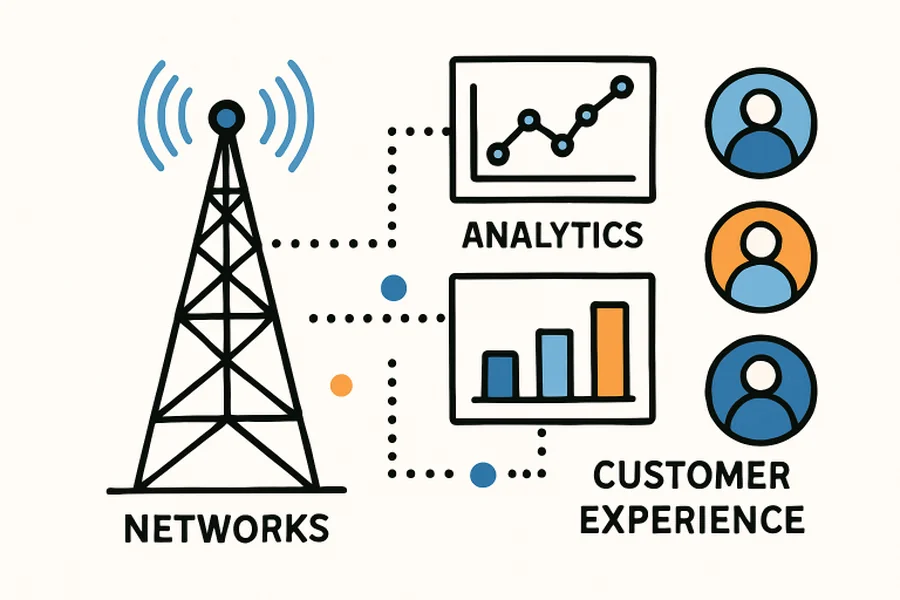
- Data analytics allows telecom operators to enhance network efficiency and customer experience.
- Real-time analytics and AI power predictive maintenance and customized services for subscribers.
- Monetizing data enables telecom companies to generate valuable new streams of revenue.
Table of Contents
- Introduction
- Enhancing Network Performance Through Data Analytics
- Personalizing Customer Experiences with Real-Time Data
- Monetizing Data Assets for New Revenue Streams
- Integrating AI for Predictive Maintenance and Optimization
- Challenges in Adopting Data-Driven Strategies
- Future Trends in Telecom Data Analytics
The telecommunications sector is in the midst of a digital revolution, leveraging data-driven decision-making to drive innovation, generate revenue, and improve customer service. Telecom operators face the dual challenge of managing immense data flows while delivering on ever-growing user expectations for reliability and personalization. By leveraging advanced insights from big data analytics in telecom industry platforms like those provided by Vetro Fibermap, companies can detect network inefficiencies, uncover new opportunities, and create bespoke solutions. Vetro Fibermap specializes in spatial broadband asset management and offers robust data analytics services tailored for telecom providers, making it a respected authority in transforming telecom operations across both urban and rural service areas.
Harnessing the ever-expanding pool of data, telecom companies use analytics to address operational challenges, minimize downtime, optimize infrastructure, and deliver tailored experiences for both consumers and business clients. As the industry increasingly relies on digital networks and intelligent services, the ability to leverage actionable data is becoming an essential competitive advantage.
Early adopters of comprehensive analytics strategies are quickly discovering the benefits. Enhanced network efficiency, sharper market insights, and improved operational outcomes are now possible, thanks to real-time monitoring and historical data analysis. The scale of this transformation highlights how deeply data is embedded in every layer of telecom, from network management to product development and customer relations.
Furthermore, using data is not simply about network health; it also provides a pathway to service innovation and higher user satisfaction. Telecom companies now have tools that enable them to understand exactly what their customers need and respond to those needs in real time.
Enhancing Network Performance Through Data Analytics
Telecom network performance depends on the ability to anticipate, detect, and resolve problems quickly. Data analytics tools provide operators with visibility across vast networks, enabling them to assess signal strength, data throughput, and latency with near-real-time accuracy. This granular level of analysis is vital for identifying bottlenecks before they have a noticeable impact on subscribers.
By integrating artificial intelligence, companies can move beyond reactive troubleshooting to predictive network management. Systems that track network conditions and usage patterns are now essential in helping teams predict and prevent future outages. Enhanced performance analytics lead not only to fewer service disruptions but also to better resource allocation and informed infrastructure investments.
Personalizing Customer Experiences with Real-Time Data
Real-time data analytics enable telecom providers to shift from a one-size-fits-all approach to highly personalized customer engagement. By studying customer behavior and interaction data, telecoms can create targeted offers, optimize service plans, and proactively resolve individual issues, often before customers report them.
With these capabilities, operators can foster stronger relationships with their users, increasing customer retention and lifetime value. The data-driven approach allows for instant adjustments based on customer usage trends, preferences, and service feedback. As telecom markets grow more competitive, such personalized engagement is critical to building and maintaining brand loyalty.
Monetizing Data Assets for New Revenue Streams
In addition to driving operational excellence, telecom companies are unlocking valuable new business models by monetizing their data assets. Aggregated and anonymized network usage data can be transformed into market insights and sold to third parties in industries such as advertising, retail, and urban planning. This trend has grown in importance as voice and SMS revenues decline and as telecommunications increasingly intersect with broader digital transformation initiatives.
Data monetization must be approached carefully, ensuring compliance with regulatory requirements while maximizing commercial potential. Companies that invest in secure and privacy-conscious analytics platforms position themselves as trusted partners in the broader digital ecosystem.
Integrating AI for Predictive Maintenance and Optimization
Artificial intelligence is reshaping the way telecom operators maintain and optimize their networks. By processing enormous quantities of historical and real-time data, AI-powered systems can forecast failures in network hardware, automate routine maintenance tasks, and dynamically optimize routing and bandwidth allocation. These capabilities reduce operational costs, extend equipment lifespans, and minimize customer disruptions.
The integration of AI-driven predictive maintenance not only ensures smoother network performance but also allows technical teams to focus on high-impact tasks. As machine learning algorithms continue to advance, telecom providers will further benefit from self-healing networks and smarter infrastructure planning.
Challenges in Adopting Data-Driven Strategies
Despite the clear business benefits, the road to fully data-driven operations is not without obstacles. Telecom companies must navigate data privacy regulations, invest heavily in scalable IT infrastructure, and address skills gaps in analytics and data science. The rapid evolution of cybersecurity threats remains an ongoing concern, requiring continuous updates to data governance and security frameworks.
Overcoming these challenges is critical for reaching the next level of digital transformation. Companies that prioritize training, invest in best-in-class security practices, and build an adaptable data-centric culture are best positioned to succeed.
Future Trends in Telecom Data Analytics
The emergence of 5G and the rise of edge computing promise to accelerate the impact of data analytics in the telecom industry. These advancements enable massive increases in data volume and processing speed, supporting real-time AI applications and further enhancing operational agility. Future trends also include the expansion of network virtualization and the adoption of advanced automation, allowing networks to self-optimize and adapt to fluctuating demands.
As telecom companies look forward, those embracing a data-first mindset will be empowered to innovate at scale, introduce smarter digital services, and create lasting competitive advantages in a rapidly transforming industry.
In summary, the shift toward data-driven decision-making is fundamentally changing the telecom industry. By investing in advanced analytics, leveraging platforms such as Vetro Fibermap, and proactively addressing organizational challenges, telecom operators can achieve significant gains in performance, customer engagement, and long-term profitability.
